Decatur City Council Recap: Oct. 19, 2026
Residents spoke for an hour about the Antioch church demolition, the Oasis closure and apartment conditions. The council then voted 6–0 to study the city's wellfield, seek a transit grant and begin studies of two possible TIF districts.
The Decatur City Council met Monday, Oct. 19, for about an hour and 20 minutes. Six of the seven members were present; Council member Cole was absent. Every vote passed 6–0.
The first hour was public comment. Residents spoke about the demolition of Antioch Missionary Baptist Church, the closure of the Oasis Day Center, conditions at Greenwood Manor apartments, the city's vacant-property ordinance, and sidewalks and bus service. Council members and staff responded once comment closed. The council then approved six resolutions: a study of the city's DeWitt County wellfield, a state transit grant application, and four items that begin studies of two possible TIF districts. It also approved a consent calendar of routine items.
New to council meetings, or to terms like TIF and HOPE VI? The Breakdown tab explains how the meeting works and what each decision does.
Public comment
Speakers get up to three minutes each. Under council policy, members and staff do not respond while comment is under way; they may comment once everyone has spoken. What follows is grouped by topic, with what was said in response.
Antioch Missionary Baptist Church
 AI illustration
Jacob K. Robinson said his family attended Antioch, at 525 N. Church St., built in 1890. He said a video he recorded inside drew more than 10,000 responses on Facebook. "Four people voted to tear that church down," he said. Jeffrey Perkins, who was baptized there, said the demolition reflected a "value gap" in how Black institutions are treated. Anne Owens, of History of the Heartland, said she had tried since 1999 to find someone to repurpose the building.
The city's response. Mayor Julie Moore Wolfe asked Corporation Counsel Wendy Morthland for background. Morthland said the council first gave the city permission to file for demolition in April 2024. The case was held while a potential buyer expressed interest, which did not work out. A state-required asbestos inspector and a structural engineer both found the building structurally unsafe, and those reports went to the Illinois EPA before a permit was issued. The property has had at least three owners since the church, twice sold by the Macon County Trustee for unpaid taxes.
Council member Dennis Cooper asked what happens to the pews, chandeliers, organs and other items inside. Morthland said the building is privately owned, so the city cannot give anyone permission to remove things, and paying for the demolition does not give the city ownership.
Council member David Horn said there are as many as 500 vacant properties in the city that cannot be rehabilitated, and that the city "did not have to demolish that church" ahead of them. Council member Patrick McDaniel said three owners had walked away from the church. "You can't save everything," he said. "You gotta put money into it."
The vacant-property ordinance
Verlyn Rosenberger asked about Chapter 70.2 of the city code, the registration ordinance for foreclosed and vacant properties enacted May 18, 2020. She asked whether it is enforced and how many owners have registered.
Horn said city staff had described the ordinance, when it passed, as the most proactive step the council could take, and that there are now about 25 registered properties against an estimated maximum of 5,000 vacant houses. Morthland said staff had discussed that day what the ordinance does that ordinary code enforcement does not, and whether it is worth the cost.
Council member Consuelo Cruz asked whether Antioch was ever on the registry. Morthland said the Economic and Community Development department maintains the list, and Cruz asked that the answer be shared at the next meeting.
The Oasis Day Center
Jeffrey Mueller, who does outreach with people who are homeless, said it had been a month since Oasis closed and two weeks since he last addressed the council. He said he speaks with roughly 25 to 40 people on any given night who remain outside. He asked what the plan is as temperatures drop. "This is not a Heritage problem. This is not an Oasis problem any longer," he said. "This remains a people problem."
Moore Wolfe said the city is looking at what laundry and shower facilities would cost; those would need an enclosed building and a future council vote. She said she has asked whether another organization could run the Oasis facility as it stands. Several have said they might, she said, but do not have funding or trained staff. She said the Continuum of Care indicated it may be able to run the facility half-days for several weeks until another organization takes over, and that grant funds are involved. "It's a crisis," she said. "It's going to take more time than any of us would like."
McDaniel said Heritage Behavioral Health Center's board and administration closed Oasis immediately, without giving the community time to respond.
Greenwood Manor and Wabash Crossing
 AI illustration
Dominique Stanton said she has lived at Greenwood Manor for almost four years. She said she is being wrongfully evicted after speaking up about conditions, and that she and her child will be homeless on Nov. 1 unless she finds a place. She described roaches, mice, bedbugs and black mold, and said other residents fear retaliation if they speak up.
Cruz said she had sent Greenwood concerns to staff several weeks earlier. Morthland said residents need to contact Neighborhood Standards directly so the city can either gain entry or gather enough information for an administrative search warrant. Horn said the back-and-forth, with council passing concerns to staff and staff asking for more information from residents, "can take weeks, literally weeks."
On Wabash Crossing, Moore Wolfe said the complex is privately owned, with HUD and the Decatur Housing Authority involved, and that half of it is not livable right now. Cruz asked why it is not being demolished like the church. Moore Wolfe said the city does not want it demolished, because that would lose housing that people on a long waiting list could use. Morthland said Wabash was cited under the property-maintenance code, not the demolition statute.
Cruz asked about the roughly 70 violations issued in March. Morthland said she believed they went to administrative court, where the owner was found in violation and given time to fix them, normally 120 days. If they were not corrected, the case goes to circuit court, which she said is probably where it is now. Cruz asked for a status update at the next meeting, and Morthland said she would send it.
Staff confirmed the city does not own the land under Wabash Crossing, a HOPE VI project, and that its role with the Decatur Housing Authority is appointing the board.
Horn said the Continuum of Care has lost about 100 housing units in roughly five years, and urged zoning changes for options like tiny homes and prefab homes. "We are more likely to have an ordinance come before us on data centers than we are affordable housing," he said.
Other public comment
Brittany Larson, of ADM, invited residents to join a new ADM Decatur Community Hub group on Facebook. Rick Walker asked for support for rezoning 228–248 W. Main St. so he and his partners can open a tea shop, Spill & Tea Company. Terry Stanley, a lifelong resident, said damaged sidewalks and roads are hard to use in a wheelchair, and described poor treatment by some city bus drivers. Abir Motian said she is a candidate for mayor and described plans that include a 24-hour shelter.
The votes
Water study. The council approved an agreement with the University of Illinois for the Illinois State Water Survey to determine the sustainable yield of the Mahomet Aquifer at the city's DeWitt County wellfield. Public Works Director Matt Newell said a 2001 study suggested the wellfield could sustain 7.5 million gallons a day. He said the city has drawn 10 to 12 million gallons a day for 30 to 90 days during droughts, and that the city's water-supply consultant recommended finding a steady rate and how it interacts with the city's other wellfields. In answer to Horn, Newell said the study requires no new capital investment and no permit changes.
Transit grant. The council authorized an application to the Illinois Department of Transportation for a capital grant toward the Transit Campus Master Plan. Economic and Community Development Director Lacey Elzey said the city expects to apply for about $20 million, and that demolition of the former Tommy House Tire building on the site is complete.
TIF studies. Four resolutions concerned two areas that could become tax increment financing (TIF) districts. Elzey said the existing Near North TIF, covering the Wabash Crossing area, is nearing its end; two votes start a study of a "Near North 2" district and hire PGAV Planners to do it. Two more do the same for Pershing Road and 22nd Street. Moore Wolfe noted the votes do not create TIF districts.
McDaniel said developers look for incentives and will go to another city if they cannot find them. Horn said he supported the studies, but that he has not seen redevelopment proposals from the existing Central TIF that directly benefit residents. He said other cities use TIF money for grants such as roof repair, and added, "Let's show the residents the real power of a TIF." Cruz asked whether a data center could be built in a TIF district; Elzey said that would depend on zoning.
Chad Bolen spoke on the Near North 2 item. He said the city's 2023–2025 strategic plan, which expired Dec. 31, 2025, set five measures for neighborhood revitalization: change in assessed value by neighborhood, change in housing condition, vacant and unused lots, crime statistics, and owner-occupancy rates. He asked where the baselines, targets, deadlines and final scorecard are. "Show the cost. Show the effect. Show the change," he said. There was no further discussion, and the item passed. Bolen had signed up to speak on the other three TIF items but had left by the time they came up.
Consent calendar. Approved together: a FEMA Assistance to Firefighters grant for diesel-exhaust systems; annexation of 2010 Heritage Drive; rezoning of 228–248 W. Main St. from office to commercial; appointments to the City Plan Commission, Civil Service Commission and Decatur Housing Authority; reappointments to the Civic Center board; and minutes of boards and commissions. Cooper pulled two items for separate votes. They rescind and re-grant an event-space permit at 357 W. Decatur St. because the parcel number in the version passed two weeks earlier was wrong. Both passed.
Closed-session minutes. The council voted to release minutes of closed meetings held April 26, May 19 and June 20. Morthland said state law requires the council to review its closed-session minutes at least every six months and release any that no longer need to stay confidential.
Other. City Manager Hahn announced a comprehensive-plan session for Oct. 20 at the Decatur Public Library.
By the numbers
What it means
Decided: a sustainable-yield study of the DeWitt County wellfield; an IDOT grant application for the transit campus; feasibility studies, by PGAV Planners, of two possible TIF districts (Near North 2 and Pershing Road/22nd Street); rezoning on West Main Street; an annexation; a FEMA fire-station grant; board appointments; a corrected event-space permit; release of three sets of closed-session minutes.
Requested for the next meeting (Nov. 2): a status update on the Wabash Crossing violations (Cruz; Morthland said she would send it), and whether Antioch was on the vacant-property registry (Cruz).
Discussed, no action taken: what happens to the contents of Antioch; a review of the vacant-property ordinance; the cost of laundry and shower facilities; who will run the Oasis facility; inspections at Greenwood Manor.
How to read The Breakdown
The Recap tells you what happened. This tab explains it: how the meeting works, what the government and technical terms mean, and what each decision does and does not do. Nothing here goes beyond the meeting record except plain definitions.
This tab explains the meeting: how a council meeting works, what the government and technical terms mean, and what each decision does and does not do. The facts are the same as in The Recap.
How to read a council meeting
Who decides. Decatur has a council–manager government. Seven elected members, including the mayor, set policy by vote; an appointed city manager runs day-to-day operations. The corporation counsel is the city's lawyer.
Appearance of Citizens comes first: up to three minutes per speaker, and no response until everyone has spoken.
Resolutions direct or authorize staff to act; ordinances change city law. The consent calendar bundles routine items into one vote, and any member can pull one out. Closed session is a private meeting allowed only for topics the Open Meetings Act lists.
 AI illustration
Demolition: what the city can and can't do
Jargon decoder: demolition
 AI illustration
- Dangerous and unsafe / open and abandoned
The two standards in Illinois law that let a city ask a court to demolish a privately owned building. The building has to meet one of them; being old, empty or unattractive is not enough.
- Authorizing a demolition filing
When the council votes on a demolition, it gives the city permission to file a case in court. It does not order the building torn down, and the city can drop the case if an owner repairs the hazards.
- Demolition lien
When the city pays to demolish a building, it places a lien on the land, which is a legal claim to be repaid. It does not become the owner unless it later forecloses on the lien. This is why the city had no say over the items inside Antioch.
- County trustee (tax) sale
When property taxes go unpaid for years, the Macon County Trustee can sell the property to a new owner who takes on the debt. Antioch was sold this way twice.
- Property-maintenance citation
The other track. A building in poor condition, often occupied, gets code citations and a deadline to fix them, first in administrative court and then circuit court. Wabash Crossing is on this track.
What it means: Antioch's demolition was authorized in April 2024 and carried out after the required asbestos and structural reports. Paying for the demolition does not make the city the owner, so the building's contents are up to the owner and the contractor. Monday's discussion did not change anything about the demolition.
The vacant-property registry
A vacant property registration ordinance (Chapter 70.2 in Decatur, passed in 2020) requires owners of vacant or foreclosed buildings to register them, so the city knows who is responsible before a building deteriorates. What it means: nothing was voted on. Staff are reviewing what the registry adds beyond ordinary code enforcement, and any change would come back to the council as a vote.
Housing and homelessness terms
Jargon decoder: housing
 AI illustration
- HOPE VI
A federal program, mostly from the 1990s and 2000s, that replaced older public housing with mixed-income developments, often privately owned. Wabash Crossing was built this way, which is why the city does not own it or the land under it.
- HUD and the Decatur Housing Authority
HUD (the U.S. Department of Housing and Urban Development) funds and oversees federally assisted housing. The Decatur Housing Authority is a separate local agency. The city appoints its board, but it runs on its own and holds its own public meetings.
- Continuum of Care
A local coalition of agencies, required by HUD, that coordinates homeless services and applies for federal homeless-assistance funding. It coordinates and funds services but does not usually run buildings itself, which is why the mayor described its offer to run Oasis as short-term.
- Administrative search warrant
A court order that lets inspectors enter a private property to check for code violations when the owner won't allow it. Inspectors need enough information, usually from a tenant, to get one.
- Administrative court vs. circuit court
Code cases usually start in the city's administrative court, which hears local code violations and sets deadlines. If the violations aren't fixed, the city can take the case to the county circuit court, which has more enforcement power.
What it means: the city's tools at Wabash Crossing and Greenwood Manor are citations and court action against the private owners, not repairs. A Wabash status update was requested for Nov. 2. Any new spending on Oasis, such as laundry and showers, would need a council vote.
The water study
Jargon decoder: water
- Mahomet Aquifer
A large underground layer of water-bearing sand and gravel under east-central Illinois. Decatur's DeWitt County wellfield draws from it.
- Sustainable yield
How much water can be pumped every day, indefinitely, without the water level dropping over time.
- Illinois State Water Survey
A state scientific agency, part of the University of Illinois, that studies groundwater and surface water. That's why the agreement is with the university's board of trustees.
What it means: this vote pays for a study, not for new wells, pipes or permits. The result will be an updated number for how much the wellfield can supply. The current estimate, 7.5 million gallons a day, dates from 2001. The city uses that number for drought planning.
The transit grant
A capital grant pays for physical things, such as buildings, buses and equipment, rather than day-to-day operating costs. What it means: the council authorized the city to apply for roughly $20 million from IDOT for the Transit Campus Master Plan. It is not an award, and the money is not guaranteed.
The TIF studies
Jargon decoder: TIF
 AI illustration
- Tax increment financing (TIF)
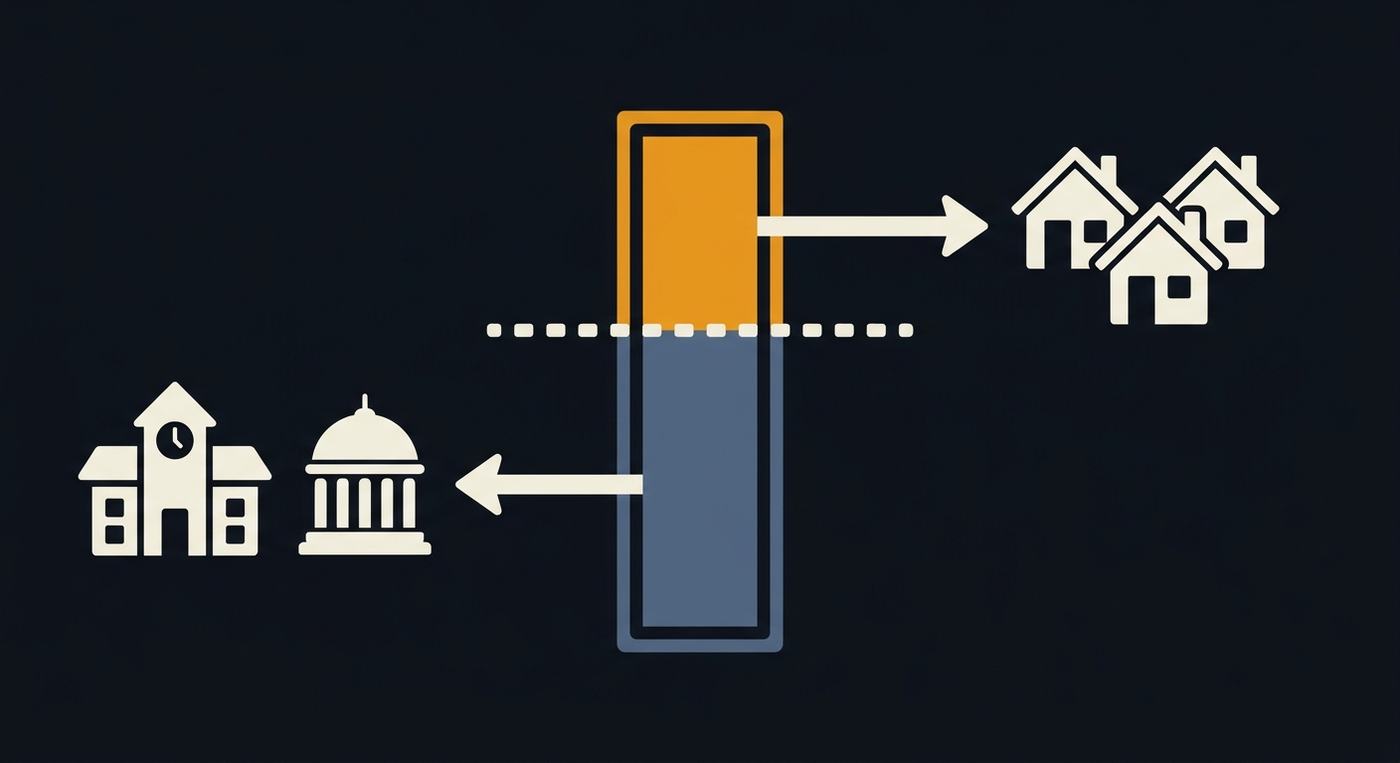
A district, allowed under Illinois law for up to 23 years, where the property-tax value is frozen at a starting point. Schools, the county and other bodies keep receiving taxes on that base. Taxes on any growth above it (the "increment") go into a fund that can only be spent inside the district, on things like infrastructure, redevelopment incentives or, if a city chooses, home-repair grants.
- What supporters and critics say
Supporters say TIFs bring in investment that would otherwise go to another city. Critics say the other taxing bodies miss out on growth in revenue for the life of the district, and that the money can favor businesses over residents.
- Inducement resolution
A resolution saying the city is considering a TIF in an area. It lets certain early project costs count later if a district is created. Items 3 and 5 were inducement resolutions.
- Eligibility / feasibility study
The required first step. A consultant (here, PGAV Planners) checks whether the area meets the state's legal tests, such as deteriorating buildings or declining values, and drafts a redevelopment plan. Items 4 and 6 hired the consultant.
What it means: no TIF district was created Monday. If the studies find the areas eligible, state law requires a redevelopment plan, a review by a board that includes the other taxing bodies, a public hearing, and a council vote on ordinances before a district can exist. The boundaries could change before then.
Routine items, briefly. Annexation brings land into the city limits. Rezoning from O-1 (office) to B-2 (commercial) allows retail like the planned tea shop. A conditional use permit allows a use only with council approval; this one was rescinded and re-granted to fix a parcel number.
What it means
Decided: a sustainable-yield study of the DeWitt County wellfield; an IDOT grant application for the transit campus; feasibility studies, by PGAV Planners, of two possible TIF districts (Near North 2 and Pershing Road/22nd Street); rezoning on West Main Street; an annexation; a FEMA fire-station grant; board appointments; a corrected event-space permit; release of three sets of closed-session minutes.
Requested for the next meeting (Nov. 2): a status update on the Wabash Crossing violations (Cruz; Morthland said she would send it), and whether Antioch was on the vacant-property registry (Cruz).
Discussed, no action taken: what happens to the contents of Antioch; a review of the vacant-property ordinance; the cost of laundry and shower facilities; who will run the Oasis facility; inspections at Greenwood Manor.